

📌 TL;DR: How to Tell If AI-Written Content is Ready to Publish
AI-written content can look polished while still lacking depth, accuracy, or a clear purpose. Five practical questions help you decide whether a draft is genuinely ready to publish.
• Check whether the draft says anything specific or simply sounds professional
• Make sure the content reflects your experience and genuine knowledge
• Confirm it answers the reader’s real question, not only the headline topic
• Review tone, facts, structure, search intent, and supporting details
• Treat editing as strategic thinking, not a quick grammar check
AI can speed up drafting, but careful human review still shapes the final quality.
How to Spot Weak AI Content Before It Reaches Your Audience
Five practical questions to help you spot vague, generic, or strategically weak AI content before it reaches your audience.
There is a particular kind of AI draft that looks perfectly respectable at first glance.
The headings are in place. The grammar is clean. The introduction leads neatly into the main points, and the conclusion ties everything together.
You read it once and think, “Yes, that seems fine.”
Then you read it again.
This time, you notice that nothing has really stayed with you. The article sounds polished, but it does not feel especially useful, distinctive, or memorable. It has done all the visible things a piece of content should do, yet somehow missed the part that gives the writing real value.
That is one of the more difficult things about working with AI.
A weak human draft often shows you where the problems are. The structure may wander, the wording might feel clumsy, or an idea has clearly not been developed enough.
AI can smooth over those weaknesses remarkably well. It can make unfinished thinking look finished.
That is why a good-looking draft still needs a careful human eye.

AI Is Very Good at Looking Convincing
AI writing tools can be genuinely helpful.
They can organise rough ideas, suggest a structure, develop a starting point, and help you make sense of notes that are all there but not yet in the right order. They are also useful when you know what you want to say but need a little help getting moving.
Used thoughtfully, AI can make the early stages of writing faster and less frustrating.
The problem starts when a polished answer is mistaken for a strong one.
AI knows what articles usually look like. It can create a smooth introduction, add a sensible list, and finish with a tidy conclusion. It can also reach for familiar phrases such as:
- “In today’s fast-paced digital world”
- “Every business is unique”
- “It is important to strike the right balance”
- “By leveraging the power of AI”
None of these lines is grammatically wrong. Some may even sound reassuring when you first read them.
The trouble is that they do not tell the reader very much.
That is why weak AI content can be harder to spot than a rough first draft. It often looks professional. The wording flows, and the tone sounds confident.
Underneath that smooth surface, though, the article may still be vague, obvious, thin, or strangely empty.
A Complete Draft Is Not Always a Useful One
Content needs more than a beginning, middle, and end. It needs a reason to exist.
A blog post should answer a useful question. A service page needs to help someone understand what you do and why it matters. A social post should offer an idea, observation, or point of view worth stopping for.
AI can produce a complete piece without getting any of that quite right.
It may cover the broad subject but miss the reader’s real concern. The draft could include plenty of information while offering very little that helps someone understand, decide, or act.
You may also find that the writing:
- repeats advice people have already seen many times
- makes broad claims without enough evidence
- leaves out important context
- sounds polished but unlike your business
- includes keywords without meeting search intent
- uses several paragraphs to make one simple point
These are not always obvious writing errors.
The sentences may be correct. The structure could make sense. Each section might appear to be doing its job.
The weakness sits underneath the wording, in the ideas the article has not developed or the questions it has not properly answered.
AI Does Not Know What You Know
An AI tool only knows the context you give it.
It has not sat in your client meetings. It has not heard the same concern raised repeatedly or noticed the small misunderstandings that stop people from moving forward.
It also has no instinct for the details you have picked up after years of doing the work.
Those details often bring content to life.
A generic article might say that clear communication builds trust. Your experience could show where that trust is usually lost, what creates confusion, and which small change helps someone feel more confident.
That is the part readers are more likely to remember.
AI can help you shape and express the idea. It cannot provide your genuine experience unless you bring that knowledge into the process.
Without enough direction, it fills the gaps with familiar patterns. The result may sound reasonable because it resembles other content on the same subject.
Reasonable can be useful as a starting point. It is rarely the best place to stop.

How to Look Beyond the Polished Draft
You do not need a complicated review process for every short post or email.
A few focused questions can help you see where a draft needs more thought, more detail, or a little more of you.
1. Is It Saying Anything Specific?
“Good content builds trust” sounds sensible, but it tells the reader very little on its own.
Which type of content? What creates that trust? Where does communication usually break down? What changes when the message becomes clearer?
Broad claims need detail before they become useful.
Look for phrases that could appear on almost any competitor’s website, then ask what they mean in this particular situation.
Add an example. Explain the consequence. Show the reader what the idea looks like in practice.
Specific writing is easier to believe because it gives people something solid to understand.
2. Does It Reflect What You Genuinely Know?
AI can sound remarkably certain about subjects it does not fully understand.
That is why claims, examples, and recommendations still need checking. The advice should reflect your experience and match what your business actually does.
It is also worth being cautious around anything that feels too neat.
Real business problems usually involve context, trade-offs, and exceptions. A draft that removes all that complexity may look clearer, but it can also become less honest.
You do not need to include every possible qualification. You do need to make sure assumptions are not being presented as facts.
3. Does It Answer the Reader’s Real Question?
A draft can cover the chosen topic without resolving the reader’s concern.
Someone looking for information about AI content may not need another list of tools or benefits. They could be worried about accuracy, originality, brand voice, search visibility, or losing control of the message.
Those concerns should shape the article.
Think about what prompted the search, not just the phrase someone typed into Google.
What does the reader need to understand by the end? Which decision are they trying to make? What uncertainty is holding them back?
Strong content answers the question beneath the question.
4. Does It Sound Like It Came From You?
Brand voice is not simply a list of preferred words.
It comes from how you explain ideas, the examples you choose, the opinions you are willing to share, and the relationship you create with the reader.
AI often falls back on familiar patterns. You may notice dramatic contrasts, overconfident claims, motivational endings, or wording that sounds professional but slightly detached.
Reading the draft aloud can help.
Would you naturally explain the idea this way to a client? Does the tone reflect your usual warmth, clarity, and level of experience?
A polished sentence is not always the right sentence.
5. Has the Content Earned Its Place?
Publishing more does not automatically improve your marketing.
Every new page or article becomes part of how people judge your knowledge, standards, and approach.
Before publishing, ask what the piece adds.
Does it provide a useful answer? Does it support the wider message of the business? Will it help the right person understand something more clearly?
Some drafts need another round of editing. Others may not need to be published at all.
Knowing the difference is part of good content judgment.
SEO Still Needs More Than Keywords
AI can add keywords, write headings, and produce a meta description in seconds.
That does not mean the content is ready to rank.
Useful SEO writing starts with search intent. You need to understand why someone is searching, what they expect to find, and how your page can offer a clearer or more helpful answer.
A draft may include every expected phrase while missing the depth the reader needs. It might answer the easiest version of the question rather than the most useful one.
This often happens when the keyword becomes the whole strategy.
Keywords help search engines understand the subject. They do not decide which examples matter, where more detail is needed, or which points deserve space.
That still requires thought.
A careful review helps you notice when a section feels thin, when an argument needs proof, or when a paragraph adds words without adding value.
AI can support SEO writing. It cannot take full responsibility for the judgment behind it.

Good Editing Is Not a Quick Clean-Up
Editing AI-assisted content is sometimes treated as the final tidy-up.
You remove a repeated word, shorten a few sentences, and check the grammar. The article then looks finished.
Those changes matter, but good editing goes much further.
An experienced editor looks at the purpose of the piece, the order of the information, and the strength of the argument. They notice when an important point has been buried or when a confident claim has not earned its place.
They also know what to cut.
AI often gives us more wording than we need. It can repeat the same idea in slightly different ways or add broad explanations to make a piece feel complete.
That is one reason AI drafts can feel long without feeling detailed.
Good editing works out which ideas deserve more room and which ones are simply taking it up.
The aim is not to make every sentence perfect. It is to make the whole article clearer, more useful, and easier to trust.
Do Not Confuse Finished With Ready
AI can help you reach a first draft faster, and that can be a real advantage.
It gives you something to work with. It helps you move past the blank page and brings shape to ideas that may still be forming.
The next stage matters just as much.
Read beyond the smooth wording. Ask what the article adds, what it proves, and where the thinking still needs work.
Then bring in the part AI cannot provide on its own.
Your knowledge. Your experience. Your standards. Your understanding of the people you want to reach.
That is where the draft starts to become something worth publishing.
FAQs About Writing and Editing Content With AI
Is It Okay to Have AI Edit My Writing?
Yes. AI can help improve clarity, shorten sentences, reorganise sections, and suggest alternative wording.
However, every change still needs human review. AI may smooth out your voice, remove useful detail, or alter the meaning while making the sentence sound more polished.
What Is the 30% Rule for AI?
There is no single, widely accepted 30% rule for AI content.
The phrase is sometimes used to suggest that humans should contribute a set percentage of the final work. In practice, content quality cannot be judged by a number alone. What matters is the accuracy, usefulness, originality, and human judgment behind the finished piece.
Is It Okay to Use AI for Content Writing?
Yes. AI can be useful for planning, outlining, developing ideas, and creating a first draft.
The output should still be checked for accuracy, relevance, tone, search intent, and value. AI works best as part of the writing process, not as a replacement for editorial judgment.
How to Edit AI-Written Content?
Start by checking the ideas before correcting the wording.
Make sure the draft answers the reader’s real question and includes useful, specific detail. Then review the facts, structure, tone, examples, and search intent. Leave grammar, repetition, and sentence-level changes until the main thinking is sound.
Want to save time and get better results from AI? My AI Content Prompts will help you create blogs, posts, and emails that actually sound like your business. Fill in the form below to download your copy.
Want more practical tips to help your website stand out and grow your business?
Join my newsletter, The Copy & Clarity Edge, for quick tips, real-world examples, and easy wins, all delivered straight to your inbox. Sign up today in the form below and give your digital presence the boost it deserves.

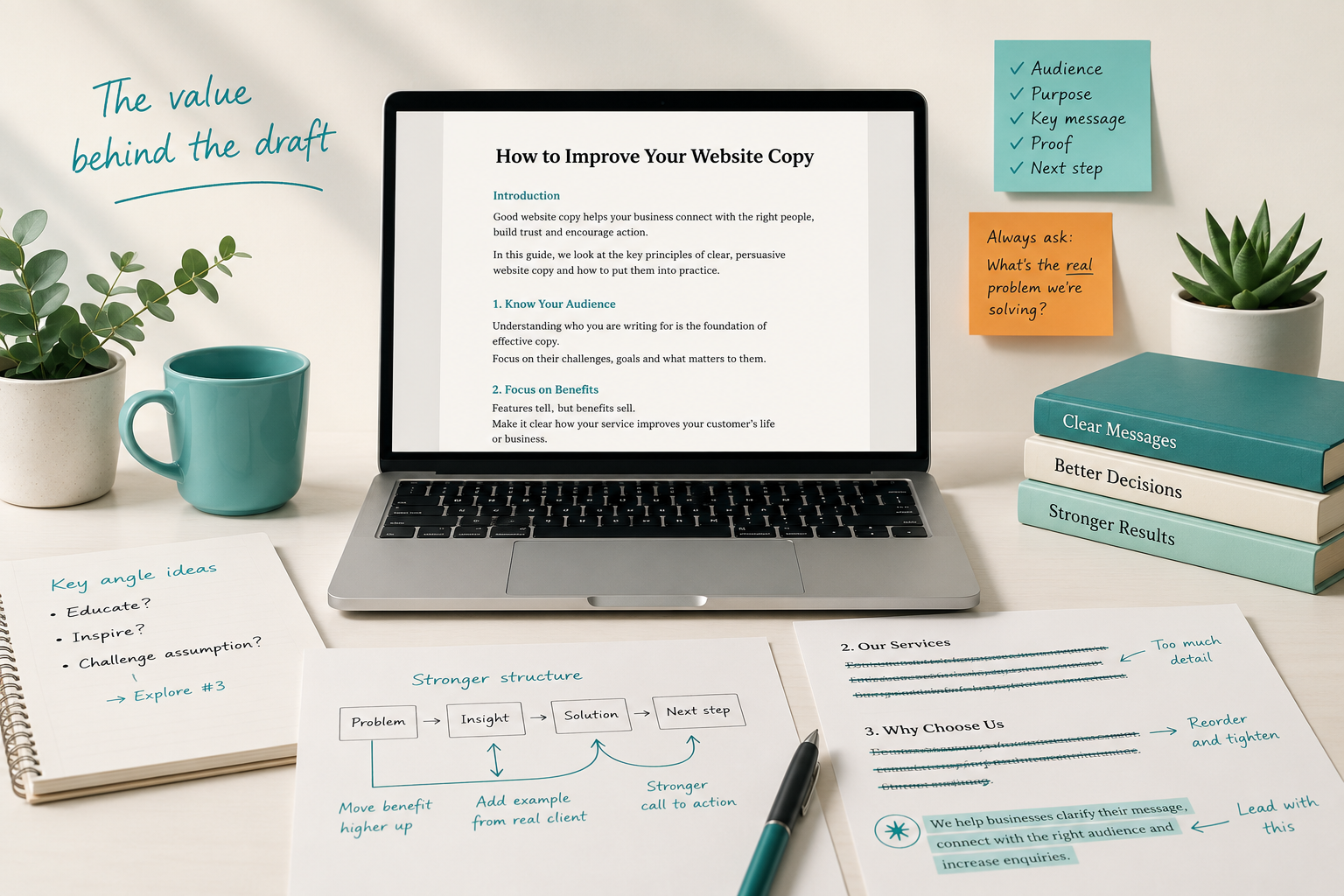
What Are You Paying An Editor For When AI Can Write The Draft?
📌 TL;DR: The Real Value Starts After The Draft AI content editing goes far beyond correcting spelling, grammar, and punctuation. It improves the thinking, structure, clarity, and usefulness behind the finished piece. AI can create a competent starting point, but it cannot replace deeper editorial judgment. The draft is only useful when someone knows what… ContinueWhat Are You Paying An Editor For When AI Can Write The Draft?
AI Can Write the Draft: But Is It Good Enough to Publish?
📌 TL;DR: How to Tell If AI-Written Content is Ready to Publish AI-written content can look polished while still lacking depth, accuracy, or a clear purpose. Five practical questions help you decide whether a draft is genuinely ready to publish. • Check whether the draft says anything specific or simply sounds professional• Make sure the… ContinueAI Can Write the Draft: But Is It Good Enough to Publish?

The Power of Clear Copywriting: How Clarity Builds Confidence
📌 TL;DR: Why Clarity Is the Heart of Great Copywriting Clear copywriting helps you share complex ideas in a simple, confident way. This post breaks down the Copy & Clarity Engine and shows how it helps you write with confidence and care. Here’s what you’ll learn: Clarity connects. Confidence converts. Meet the Copy & Clarity… ContinueThe Power of Clear Copywriting: How Clarity Builds Confidence

Personal Brand Writing with AI Tools: Find Your Authentic Voice
📌 TL;DR: Using AI Tools Without Losing What Makes You, You Personal brand writing is changing fast as AI tools reshape how we create and share content. This guide shows you how to keep your voice clear, authentic, and human while still using technology to support your work. Here’s what you’ll learn: How to Keep… ContinuePersonal Brand Writing with AI Tools: Find Your Authentic Voice

AI for SEO Content: A Practical Guide for Small Business Owners
📌 TL;DR: Smart AI SEO for Small Business Growth AI can help small businesses grow, but only when used wisely. Combine AI tools with copywriting expertise to stay visible, authentic, and safe online. The Buzz Around AI for SEO Content If you run a small business, you’ve probably noticed the buzz around AI for SEO… ContinueAI for SEO Content: A Practical Guide for Small Business Owners

The Simple Way to Train ChatGPT to Write in Your Voice
📌 TL;DR: Train ChatGPT to Write in Your Voice ChatGPT can be a powerful content tool, but it won’t sound like your brand, unless you train ChatGPT to write in your voice. By teaching it your style, values, and audience, you turn bland AI text into copy that connects and sells. The secret isn’t the… ContinueThe Simple Way to Train ChatGPT to Write in Your Voice

How to Improve Blog Rankings (Even if You’re Not an SEO Pro)
📌 TL;DR: Simple Blog Tips That Boost Your Rankings Want to boost your blog rankings without getting bogged down in jargon? This guide shares five simple SEO tips tailored for women-led businesses. With relatable examples and practical steps, you’ll learn how to write posts that attract the right readers and turn your blog into a… ContinueHow to Improve Blog Rankings (Even if You’re Not an SEO Pro)

9 Common Website Mistakes (And How to Dodge Them)
📌 TL;DR: Key Website Copy Errors to Avoid for Better Results Avoiding common website mistakes can greatly improve your site’s performance. Here’s how to fix a few key issues: But these are just the basics. Fixing common issues like poor structure, unclear messaging, and mobile optimisation can transform your site and boost engagement. Want to… Continue9 Common Website Mistakes (And How to Dodge Them)

Content Writing Tips for Small Business That Connect & Convert
📌 TL;DR: Quick Takeaway for Busy Readers Struggling to write content that connects and converts? This guide shares practical tips for small business owners who want to sound real, build trust, and inspire action. Learn how to write like you talk, keep it simple, and add heart to every post. Main Points: The Power of… ContinueContent Writing Tips for Small Business That Connect & Convert

10 SEO Mistakes Small Businesses Make & How to Fix Them
📌 TL;DR Small businesses often make easy-to-fix SEO mistakes—from skipping keyword research to neglecting mobile experience. This article covers 10 common pitfalls and offers clear fixes. Plus, it explains how to build trust and authority online using Google’s E‑E‑A‑T framework. What you’ll walk away with: How to choose the right keywords (no guesswork) Why less… Continue10 SEO Mistakes Small Businesses Make & How to Fix Them

Stress-Free SEO Writing: How to Make SEO Work for You
Do you feel overwhelmed by SEO? You’re not alone. Many women-led small businesses look at SEO writing and see a tangled web of jargon, rules, and pressure. Here’s the good news: stress-free SEO writing is possible. You can make SEO work for you, even if you’re not a tech whiz or marketing pro. What Is… ContinueStress-Free SEO Writing: How to Make SEO Work for You

The Future of Hospitality: A Tech-Driven Revolution
AI and Automation: Transforming Guest Experiences In today’s fast-changing hospitality world, technology isn’t just a convenience—it’s a must. With global hotel revenue set to reach $2.1 trillion in 2024, using the latest tech is key. It helps improve guest experiences and stay competitive. AI is transforming the world of hospitality in ways that feel almost… ContinueThe Future of Hospitality: A Tech-Driven Revolution

Emotional Language in Successful Content: The Power of Words
The Power of Words in Successful Content Marketing In the current landscape of content marketing, creating a genuine connection with your audience is more crucial than ever. Emotional language is a powerful tool that can make your content stand out. By adding a human touch, small to medium-sized businesses can connect with their audience on… ContinueEmotional Language in Successful Content: The Power of Words

Write Fun Website Copy (That Sells!): Engage Your Audience
Grab Attention, Drive Conversions, Sell More Products In today’s crowded online landscape, forget forgettable website copy. Engaging content that sparks a smile or chuckle? That’s your secret weapon. A captivating website is your storefront window. Fun copywriting connects with your audience on a deeper level. It boosts engagement and, in the end, helps your bottom… ContinueWrite Fun Website Copy (That Sells!): Engage Your Audience

Case Studies: Building Brand Champions with Success Stories
How Case Studies Can Improve Your ROI Looking to boost your company’s ROI with a tool that packs a punch? Meet the case study. For small to medium-sized business marketing managers, case studies are more than just a marketing tactic. They are a powerful way to share success stories. These stories help build trust and… ContinueCase Studies: Building Brand Champions with Success Stories

Content That Converts: 5 Easy Steps to Write Magnetic Content
Content That Converts: 5 Easy Steps to Write Magnetic Copy Let’s ditch the writer’s block and create content that converts. Ignite sales with your writing. Content creation often feels like a chore because we approach it in the wrong way. Gone are the days of dry, academic writing. Today, it’s about connecting with your ideal… ContinueContent That Converts: 5 Easy Steps to Write Magnetic Content

Landing Page Copywriting: Write to Convert
9 Powerful Copywriting Tips to Skyrocket Your Landing Pages Right, let’s talk landing pages. You’ve got this fantastic new page, but no one’s signing up. Fear not, I’m here to help. Landing pages are all about that first impression, and you only get one chance. It’s like meeting your date for the first time. But… ContinueLanding Page Copywriting: Write to Convert

SEO Content Writing: Master the Art of Organic Search Results
In today’s digital age, businesses are increasingly recognizing the importance of Search Engine Optimization (SEO) to boost website visibility and attract organic traffic. To achieve top search engine rankings and attract a relevant audience, mastering SEO content writing is crucial. In this article we dive into the world of SEO content writing, exploring effective strategies… ContinueSEO Content Writing: Master the Art of Organic Search Results


