
📌 TL;DR: The Real Value Starts After The Draft
AI content editing goes far beyond correcting spelling, grammar, and punctuation.
It improves the thinking, structure, clarity, and usefulness behind the finished piece.
- Strong editing questions weak claims, vague ideas, and unsupported assumptions.
- Structural changes help readers follow the argument and find key information.
- Line editing removes fluff, repetition, awkward wording, and unnecessary uses of “that.”
- Fact-checking reduces the risk of publishing confident but inaccurate information.
- Experienced judgment decides what to strengthen, move, rewrite, or remove.
AI can create a competent starting point, but it cannot replace deeper editorial judgment.
The draft is only useful when someone knows what should happen next.
AI Content Editing: What Are You Paying An Editor For?
AI can produce a draft in seconds. It can suggest headlines, organise ideas, rewrite awkward sentences, and turn a rough collection of notes into something that appears finished.
That naturally raises a question for businesses. What are you paying a writer, editor, or content strategist for when AI can already produce the words?
It is a fair question. The answer is no longer simply “better writing.”
You are paying for the thinking, direction, and editorial judgment that determine what the content should say, how it should work, and whether it is strong enough to publish.
The Draft Is Becoming The Cheapest Part
Producing words once took up a large part of the content process. A writer would research the subject, develop an angle, build the structure, and create the first version from a blank page.
The draft was visible evidence of the work involved. AI has changed that.
A business owner can now open a tool, describe what they need, and receive a reasonable article or web page almost immediately. That does not mean the content is ready. It means the first visible stage has become faster and cheaper.
The more valuable work often happens before and after the draft appears. It lies in choosing the direction, questioning assumptions, shaping the argument, and carrying out the deeper editing many people never realise is needed.
Editing Is More Than Correcting Mistakes
Many people think editing means checking spelling, grammar, and punctuation. Those checks matter, but they form only one part of the process.
A piece can be grammatically correct and still be weak. It may repeat the same idea several times, bury the strongest point, or appear logical while leading the reader in circles.
Important information can disappear beneath general background. Polished sentences may also disguise a lack of substance.
Proofreading will not solve those problems. Deeper editing looks beyond individual errors and examines the meaning, structure, logic, emphasis, and usefulness of the whole piece.
An editor may need to:
- Remove repetition and padding
- Move sections into a clearer order
- Question unsupported claims
- Strengthen vague explanations
- Reduce unnecessary wording
- Cut sentences or sections that add nothing
- Improve the flow between ideas
- Clarify what the writer is trying to say
- Decide whether the draft is worth publishing at all
This work may be described as substantive, developmental, structural, or line editing. The labels can overlap, but the purpose is similar.
The editor is not simply correcting the words. They are strengthening the thinking behind them.
Finding The Problem Behind The Brief
A client may ask for a new website page because the existing copy feels flat. The obvious response is to rewrite it, but the wording may not be the real issue.
Perhaps the offer is unclear. The page may be speaking to several audiences at once or leading with details the buyer does not care about.
A stronger headline will not fix weak positioning. Cleaner sentences cannot rescue an offer that has not been properly explained.
An experienced strategist or editor knows when to stop writing and ask better questions.
What is this page meant to achieve? Who needs to act after reading it? What is stopping that person from acting now?
Those questions can change the whole direction of the work. Sometimes the original request does not need improving. It needs challenging.
Choosing The Right Direction
AI can generate several angles for an article. Some may be interesting, while others will sound familiar because they reflect what has already been published many times.
Choosing between them requires more than language skills. The strongest angle needs to suit the audience, support the wider strategy, and give the business a reason to publish the piece.
That may mean rejecting the most obvious subject.
A generic article about improving website copy could cover clear headlines, customer benefits, and strong calls to action. These are useful points, but they are easy to find elsewhere.
A more valuable article might explore why a technically polished website still fails to persuade. That opens a more specific discussion about positioning, priorities, buyer understanding, and trust.
AI can suggest both ideas. Someone still has to decide which one is worth pursuing.
Structure, Meaning, And Emphasis
Good structure is not simply a matter of adding headings and bullet points. The order of the ideas affects how well the reader understands the subject.
An article may begin with several paragraphs of context before reaching the answer. A website page might explain the company’s history before telling the customer what the service does.
The information may be relevant, but it has appeared in the wrong place.
Structural editing looks at the piece as a whole. It asks whether the opening creates interest, whether each section leads naturally into the next, and whether the main point receives enough attention.
It also questions material that is individually well written but weakens the wider argument. That is one of the hardest parts of editing.
A paragraph may be accurate, polished, and pleasant to read. It can still be unnecessary.
The question is not only whether a section is good. It is whether it belongs.
Deciding What Deserves Attention
Businesses often have too much information rather than too little. They want to explain every feature, include every benefit, answer every possible question, and make sure nothing important is left out.
AI is happy to help. It can expand almost any point, create more sections, and turn a short draft into a comprehensive guide.
The result may be thorough. It may also bury the one thing the reader needed to understand.
Good content depends on emphasis. Someone has to decide what belongs near the top, which idea needs more explanation, and what can be removed.
That choice often matters more than the individual sentences. A reader may never reach the strongest point if it appears after several paragraphs of background information.
A useful benefit can also lose its force when surrounded by weaker claims. Editorial judgment determines what the reader notices, remembers, and acts on.
The Value Of An Informed Challenge
AI is designed to produce an answer. It does not always stop to ask if the information it has been given is complete, accurate, or strategically sound.
A client may describe their audience in broad terms, and the tool accepts the description without question. An experienced writer or editor may notice that the supposed audience includes people with very different needs.
The content then becomes vague because the message is trying to speak to everyone at once.
A good editor can challenge the assumption before more copy is produced. They may ask which customer is most valuable, what usually prompts an enquiry, or why people choose this business over another.
That challenge can feel inconvenient, but it is often where much of the value sits.
The job is not to agree with every point in the brief. It is to notice where the brief may be holding the content back.
Clarity At Sentence Level
Deeper editing also happens close to the words. Line editing looks at how each sentence and paragraph contributes to the reader’s understanding.
It removes fluff, tightens vague language, and improves rhythm without stripping away the writer’s voice. That may involve cutting unnecessary uses of “that,” removing throat-clearing openings, breaking up overloaded sentences, or replacing general claims with something more precise.
It can also mean restoring natural flow.
AI drafts often contain sentences that are technically correct but feel mechanical. They may rely on repeated structures, overused transitions, or phrases that sound polished without adding meaning.
A good editor notices these patterns. They do not simply swap one word for another.
They reshape the writing so the language supports the idea instead of getting in its way.
What A Good Editor Removes
AI makes adding content easy. Removing it requires confidence.
A tool can give you ten benefits, seven examples, and five common mistakes. That may feel like good value because there is plenty on the page.
An editor may look at the same draft and cut half of it. Repeated ideas go, weak claims disappear, and unnecessary words are removed.
Sections that interrupt the argument may also be deleted, even when they are perfectly well written.
The finished piece becomes shorter but more useful. That work is easy to underestimate because the reader never sees what was taken away.
They only experience a page that feels clear, focused, and easy to follow.
The value does not lie in keeping the greatest number of words. It lies in knowing which ones deserve to remain.
Reducing Risk Before Publication
A polished draft can still contain serious problems. Statistics may be outdated, claims can sound stronger than the evidence allows, and examples might appear convincing but fail under closer inspection.
AI-generated research is particularly difficult because an incorrect statement can be presented with complete confidence.
Someone needs to check the facts, question the sources, and recognise where a claim requires softening or removing.
There are strategic risks too. A page may create the wrong expectation about a service, while an article can contradict the business’s wider positioning or make a promise the delivery team cannot support.
These issues are often more expensive than a clumsy sentence. Catching them before publication can protect both the content and the business behind it.
Experience Changes What You Notice
Judgment is not a vague instinct that appears from nowhere. It develops through years of work.
A copywriter learns which questions uncover the strongest customer benefit. An editor becomes quicker at spotting when an article repeats itself, avoids its central point, or sounds more convincing than it really is.
A strategist sees patterns across projects. They recognise the difference between a writing issue and a deeper problem with the audience, offer, purpose, or positioning.
Experience also includes the mistakes.
A project that went badly may change the questions asked at the beginning of every future brief. Content that failed to perform can expose an assumption that should not be repeated.
AI can draw on enormous amounts of information. It does not have your history with real clients, awkward decisions, conflicting priorities, and work that had to succeed outside the draft.
That experience changes what you notice and what you are prepared to challenge.
The Real Product Is Better Judgment
The question is no longer simply whether a writer can produce a better first draft than AI. Sometimes they can. On other occasions, AI will create a perfectly usable starting point.
The greater value lies elsewhere.
Can the person identify the real problem? Will they challenge a weak brief? Do they understand the difference between proofreading and deeper editing?
Can they improve the structure, logic, and meaning? Do they know what deserves emphasis?
Will they recognise a polished answer that is still wrong for the reader? Can they remove what adds nothing and strengthen what matters?
These decisions shape the result long before the final spelling check.
AI Has Not Removed The Need For Expertise
AI has made content production faster. That is useful. Businesses can explore ideas, organise information, and move past the blank page with less effort.
But faster production does not guarantee better decisions. It may even make weak content harder to spot because the draft looks so competent.
That is why experienced content support still matters.
You are not only paying someone to write or correct mistakes. You are paying them to see what the tool cannot, challenge what the business has overlooked, and carry out the deeper editing that turns a competent draft into something clear, useful, and worth publishing.
AI can produce the draft.
The real value lies in knowing what should happen next.
Frequently Asked Questions
What Does An AI Content Editor Do?
An AI content editor can review a draft and suggest changes to its grammar, wording, tone, structure, and readability. It may also identify repetition, shorten long passages, or rewrite unclear sentences.
However, deeper AI content editing still needs human judgment. A tool cannot reliably decide if the argument is strong enough, whether the advice reflects real experience, or if the finished piece deserves to be published.
What Is The Best AI For Editing?
There is no single best AI for every editing task. ChatGPT, Claude, and Gemini can all help writers revise wording, develop arguments, and improve drafts, although their features and responses vary.
The result depends heavily on the instructions, context, and examples the tool receives. AI can support the editing process, but it should not be relied on to make every structural, factual, or strategic decision.
What Is The Difference Between Editing And Proofreading?
Proofreading is usually the final check for spelling, punctuation, grammar, formatting, and small errors before publication.
Editing goes much deeper. It can involve reorganising sections, removing repetition, questioning weak claims, improving logic, sharpening the meaning, and cutting material that does not help the reader. A draft may pass a proofread and still require substantial editing.
Want to save time and get better results from AI? My AI Content Prompts will help you create blogs, posts, and emails that actually sound like your business. Fill in the form below to download your copy.
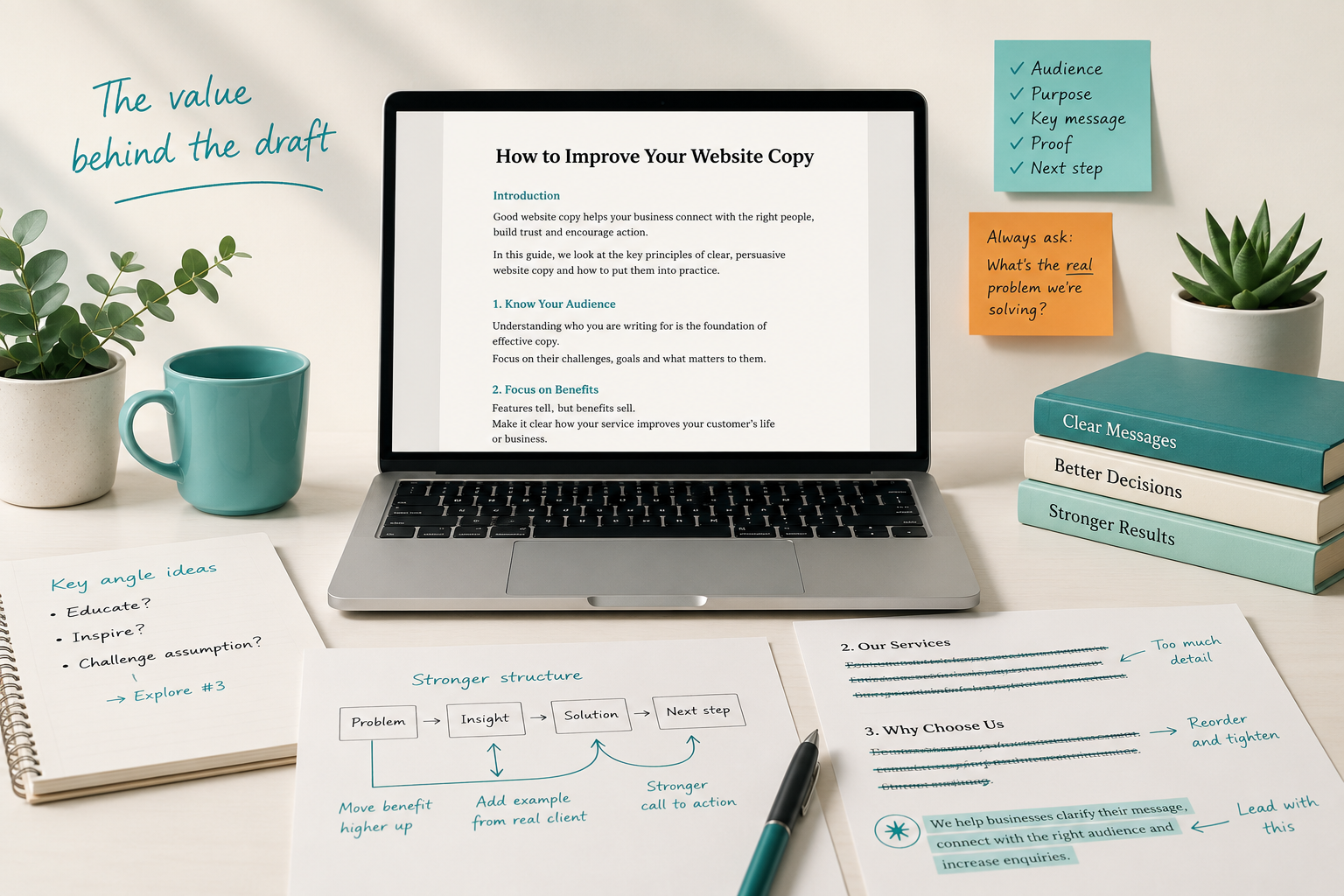
What Are You Paying An Editor For When AI Can Write The Draft?
📌 TL;DR: The Real Value Starts After The Draft AI content editing goes far beyond correcting spelling, grammar, and punctuation. It improves the thinking, structure, clarity, and usefulness behind the finished piece. AI can create a competent starting point, but it cannot replace deeper editorial judgment. The draft is only useful when someone knows what… ContinueWhat Are You Paying An Editor For When AI Can Write The Draft?

AI Can Write the Draft: But Is It Good Enough to Publish?
📌 TL;DR: How to Tell If AI-Written Content is Ready to Publish AI-written content can look polished while still lacking depth, accuracy, or a clear purpose. Five practical questions help you decide whether a draft is genuinely ready to publish. • Check whether the draft says anything specific or simply sounds professional• Make sure the… ContinueAI Can Write the Draft: But Is It Good Enough to Publish?

The Power of Clear Copywriting: How Clarity Builds Confidence
📌 TL;DR: Why Clarity Is the Heart of Great Copywriting Clear copywriting helps you share complex ideas in a simple, confident way. This post breaks down the Copy & Clarity Engine and shows how it helps you write with confidence and care. Here’s what you’ll learn: Clarity connects. Confidence converts. Meet the Copy & Clarity… ContinueThe Power of Clear Copywriting: How Clarity Builds Confidence

Personal Brand Writing with AI Tools: Find Your Authentic Voice
📌 TL;DR: Using AI Tools Without Losing What Makes You, You Personal brand writing is changing fast as AI tools reshape how we create and share content. This guide shows you how to keep your voice clear, authentic, and human while still using technology to support your work. Here’s what you’ll learn: How to Keep… ContinuePersonal Brand Writing with AI Tools: Find Your Authentic Voice

AI for SEO Content: A Practical Guide for Small Business Owners
📌 TL;DR: Smart AI SEO for Small Business Growth AI can help small businesses grow, but only when used wisely. Combine AI tools with copywriting expertise to stay visible, authentic, and safe online. The Buzz Around AI for SEO Content If you run a small business, you’ve probably noticed the buzz around AI for SEO… ContinueAI for SEO Content: A Practical Guide for Small Business Owners

The Simple Way to Train ChatGPT to Write in Your Voice
📌 TL;DR: Train ChatGPT to Write in Your Voice ChatGPT can be a powerful content tool, but it won’t sound like your brand, unless you train ChatGPT to write in your voice. By teaching it your style, values, and audience, you turn bland AI text into copy that connects and sells. The secret isn’t the… ContinueThe Simple Way to Train ChatGPT to Write in Your Voice

How to Improve Blog Rankings (Even if You’re Not an SEO Pro)
📌 TL;DR: Simple Blog Tips That Boost Your Rankings Want to boost your blog rankings without getting bogged down in jargon? This guide shares five simple SEO tips tailored for women-led businesses. With relatable examples and practical steps, you’ll learn how to write posts that attract the right readers and turn your blog into a… ContinueHow to Improve Blog Rankings (Even if You’re Not an SEO Pro)

9 Common Website Mistakes (And How to Dodge Them)
📌 TL;DR: Key Website Copy Errors to Avoid for Better Results Avoiding common website mistakes can greatly improve your site’s performance. Here’s how to fix a few key issues: But these are just the basics. Fixing common issues like poor structure, unclear messaging, and mobile optimisation can transform your site and boost engagement. Want to… Continue9 Common Website Mistakes (And How to Dodge Them)

Content Writing Tips for Small Business That Connect & Convert
📌 TL;DR: Quick Takeaway for Busy Readers Struggling to write content that connects and converts? This guide shares practical tips for small business owners who want to sound real, build trust, and inspire action. Learn how to write like you talk, keep it simple, and add heart to every post. Main Points: The Power of… ContinueContent Writing Tips for Small Business That Connect & Convert

10 SEO Mistakes Small Businesses Make & How to Fix Them
📌 TL;DR Small businesses often make easy-to-fix SEO mistakes—from skipping keyword research to neglecting mobile experience. This article covers 10 common pitfalls and offers clear fixes. Plus, it explains how to build trust and authority online using Google’s E‑E‑A‑T framework. What you’ll walk away with: How to choose the right keywords (no guesswork) Why less… Continue10 SEO Mistakes Small Businesses Make & How to Fix Them

Stress-Free SEO Writing: How to Make SEO Work for You
Do you feel overwhelmed by SEO? You’re not alone. Many women-led small businesses look at SEO writing and see a tangled web of jargon, rules, and pressure. Here’s the good news: stress-free SEO writing is possible. You can make SEO work for you, even if you’re not a tech whiz or marketing pro. What Is… ContinueStress-Free SEO Writing: How to Make SEO Work for You

The Future of Hospitality: A Tech-Driven Revolution
AI and Automation: Transforming Guest Experiences In today’s fast-changing hospitality world, technology isn’t just a convenience—it’s a must. With global hotel revenue set to reach $2.1 trillion in 2024, using the latest tech is key. It helps improve guest experiences and stay competitive. AI is transforming the world of hospitality in ways that feel almost… ContinueThe Future of Hospitality: A Tech-Driven Revolution

Emotional Language in Successful Content: The Power of Words
The Power of Words in Successful Content Marketing In the current landscape of content marketing, creating a genuine connection with your audience is more crucial than ever. Emotional language is a powerful tool that can make your content stand out. By adding a human touch, small to medium-sized businesses can connect with their audience on… ContinueEmotional Language in Successful Content: The Power of Words

Write Fun Website Copy (That Sells!): Engage Your Audience
Grab Attention, Drive Conversions, Sell More Products In today’s crowded online landscape, forget forgettable website copy. Engaging content that sparks a smile or chuckle? That’s your secret weapon. A captivating website is your storefront window. Fun copywriting connects with your audience on a deeper level. It boosts engagement and, in the end, helps your bottom… ContinueWrite Fun Website Copy (That Sells!): Engage Your Audience

Case Studies: Building Brand Champions with Success Stories
How Case Studies Can Improve Your ROI Looking to boost your company’s ROI with a tool that packs a punch? Meet the case study. For small to medium-sized business marketing managers, case studies are more than just a marketing tactic. They are a powerful way to share success stories. These stories help build trust and… ContinueCase Studies: Building Brand Champions with Success Stories

Content That Converts: 5 Easy Steps to Write Magnetic Content
Content That Converts: 5 Easy Steps to Write Magnetic Copy Let’s ditch the writer’s block and create content that converts. Ignite sales with your writing. Content creation often feels like a chore because we approach it in the wrong way. Gone are the days of dry, academic writing. Today, it’s about connecting with your ideal… ContinueContent That Converts: 5 Easy Steps to Write Magnetic Content

Landing Page Copywriting: Write to Convert
9 Powerful Copywriting Tips to Skyrocket Your Landing Pages Right, let’s talk landing pages. You’ve got this fantastic new page, but no one’s signing up. Fear not, I’m here to help. Landing pages are all about that first impression, and you only get one chance. It’s like meeting your date for the first time. But… ContinueLanding Page Copywriting: Write to Convert

SEO Content Writing: Master the Art of Organic Search Results
In today’s digital age, businesses are increasingly recognizing the importance of Search Engine Optimization (SEO) to boost website visibility and attract organic traffic. To achieve top search engine rankings and attract a relevant audience, mastering SEO content writing is crucial. In this article we dive into the world of SEO content writing, exploring effective strategies… ContinueSEO Content Writing: Master the Art of Organic Search Results


